[Lab Note #1] AI-generated images and copyright. Why it might not matter.
A practical look at what authorship means in AI-assisted workflows.

All this news about the Supreme Court declining to hear the AI + copyright case has me thinking about my agentic art collective project, Mortal Prophet.
It’s a creative collaboration between me (Second Realm) and my semi-autonomous AI agent (Iris Dayrise) powered by OpenClaw. The outputs of which are AI-generated.
Re: OpenClaw, you may have seen me write about it on LinkedIn. But essentially it’s a locally run AI agent that you can use to interact with apps, browsers, tools, and files on your device while still tapping into the best LLM tools on the market.
Let me be clear in saying that I consider the Mortal Prophet outputs to be CC0 already so I’m not emotionally affected by the lower court’s ruling or the Supreme Court’s decision not to hear the case.
CC0 distribution is a meaningful part of my art practice as I believe provenance can be attributed via and bolstered by blockchain tech.
That said, today’s note is a thought exercise about AI + copyright through the lens of my recent artwork. Taking this thought exercise one step further, I’m outright conceding that the output is not copyrightable.
So now I’m forced to consider what parts of the the creative process outside of the generated image is human-authored.
The idea I’m circling here is: if I use AI like a tool and I’m the one making the creative decisions, the result can still be “human-authored” in the copyright sense.
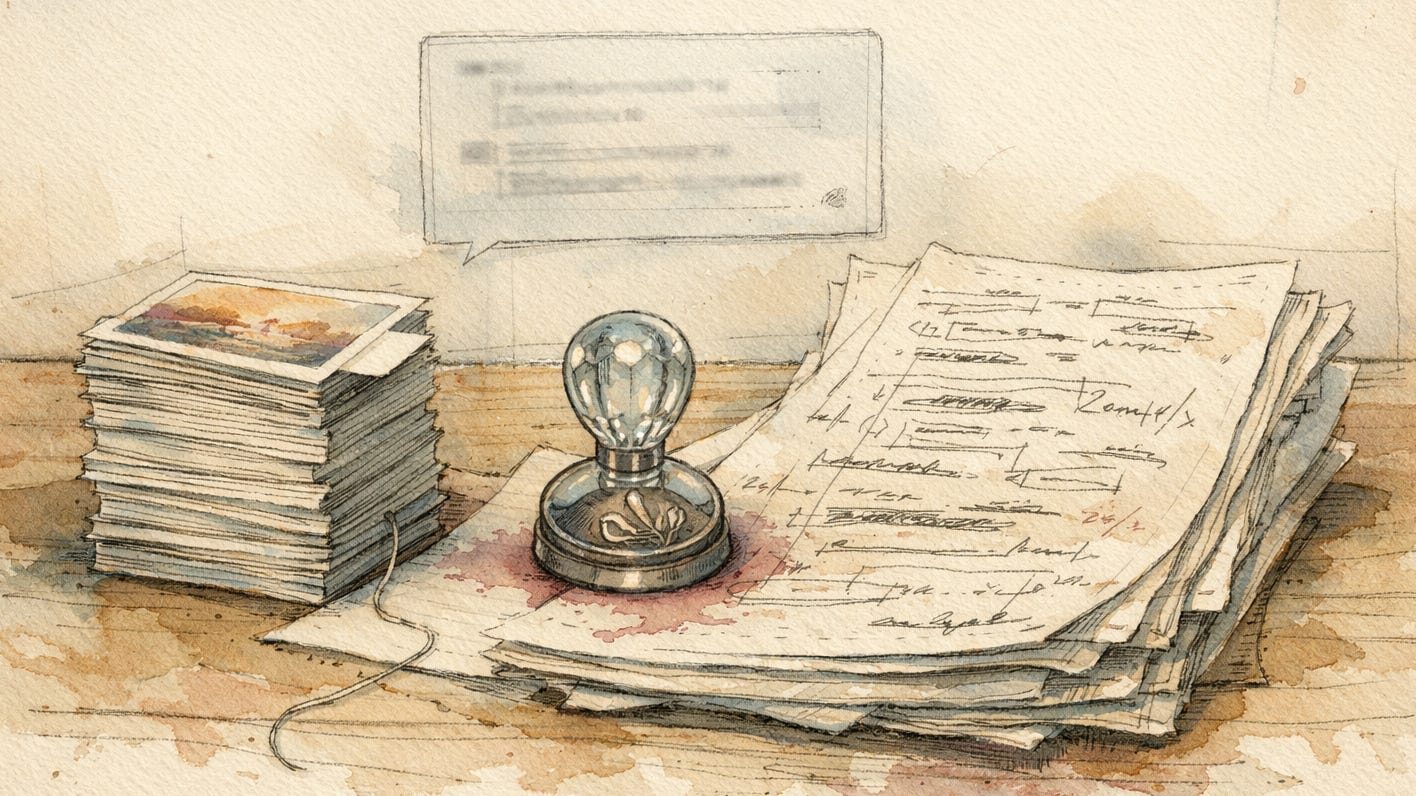
And where I’ve come to, is that the process matters in this sense. The words you use to generate the outputs are the art. The image is just ephemera. It’s a post card. A souvenir of a creative act. Or in the case of Mortal Prophet’s ech0 project, they’re 743 souvenirs.
I actually, believe this is true of all art. The finished product is a souvenir of the creative process.
What copyright has enabled, in my humble opinion, is the accelerated commodification of souvenirs (i.e., Warhol Foundation, Estate of Basquiat, etc.). And similar IP landlords, à la Disney.
However, enforcing protections is not necessarily in favor of all creators equally. Just those who can afford to enforce it. But that’s a whole other topic for another day on another platform.
But I digress…
So, if the image for the AI outputs for the ech0 project are not protected by copyright law, what is?
Well, unfortunately it’s the case, that my creative partner here, Iris (the AI-enabled assistant), actually outputs the prompts I use by going through an automated multi-step method to arrive at the final prompt.
Iris selects a quote from database
It reinterprets that quote into a dream based on what it knows about me
It takes that dream and reimagines it as a surrealscape given a set of instructions
It selects the appropriate palette and motifs to use
And then outputs a prompt that I use to have a model create the image
Definitionally, according to the lower courts ruling, the individual prompts the generated for each image may not be copyrightable for the same reason an AI generated image isn’t.
So where does that actually leave me with copyright and the creative process in this thought exercise if not even the prompts for each generated image are protected by copyright?
The code! The fucking code.
It’s well-established law that code (and the written word for that matter) is protected under copyright law.
And while the code in this case is very detailed set of custom psuedo-code instructions, that would be protected under copyright b/c it’s human-authored by me. The creative process I went through resulted in the output of a skill – OpenClaw’s concept for mini-programs you give your local agent.
So while the individual images and the individual prompts generated to create those images are not copyrightable. The code/skill that generates the whole thing would be.
Given that, I owe it to myself as an artist to capture the entire creative process in a cohesive way. It’s something I plan on doing later than sooner. I’m still digesting much of the process itself. Mostly because I’m honestly still excited to see the Mortal Prophet outputs each day.
So, to close out this line of thinking…
I’m not claiming ownership of the method that Iris uses to arrive at the final prompt. Nor am I claiming ownership of the AI-generated output. But I am claiming ownership of the system of instructions for how the process is implemented. That’s what I, the artist, created. And that’s what is copyrightable.
In the AI era, the work is the process and the provenance trail that documents it, not just the souvenir image that comes out the other side. And I think this has always been true. The act of making is the work. That seems to get lost in all of this.
A thread I want to pull on next is this. If the creative act I underwent is a merging of coding and storytelling, is this a yet undefined creative act. And what does that suggest for knowledge work.
What do you think?
P.S. It’s important to mention that I see my creative pursuits as something that informs my professional pursuits and vice versa. So, you’ll see those intertwining threads throughout future Future of Work Notes.
Join me in the conversation by following me Eric P. Rhodes, and check out my latest research at the Future of Work Lab.